

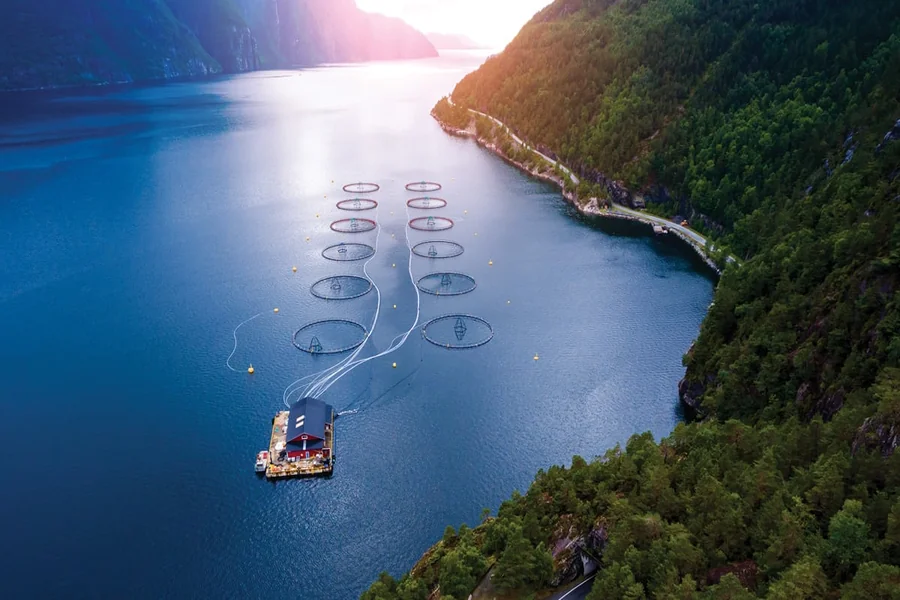
Global demand for seafood has been climbing steadily for decades, and wild-catch fisheries have largely stopped keeping pace. Overfished stocks, tighter environmental regulations, and unpredictable ocean conditions have pushed the industry toward a controlled alternative: aquaculture. The numbers are hard to argue with. The global aquaculture market is forecast to reach roughly $626 billion by 2035, with farmed fish already accounting for more than half of the seafood consumed worldwide.
The growth is real, and the infrastructure challenge is equally real.
A Supply Problem That Wild Fishing Can’t Fix
Fish farming has existed in various forms for thousands of years, but the version taking shape today barely resembles its origins. Modern operations run around the clock, managing water chemistry, feed automation, pathogen control, and real-time performance data across facilities that can house millions of fish at once. Offshore pens, land-based tanks, well boats, hatcheries, each comes with its own technical demands, and all of them rely on water moving continuously and cleanly through the system.
That dependency on flow is where purpose-built aquaculture pumps become critical. Without reliable water circulation, oxygen levels drop, waste accumulates, and fish health deteriorates fast. In a commercial operation, even a brief disruption carries serious financial consequences.
Why Water Management Is the Real Challenge
The Case for Recirculating Systems
The development that has changed the industry most over the past decade is the spread of Recirculating Aquaculture Systems, commonly known as RAS. Instead of drawing fresh water continuously, these closed-loop setups filter, treat, and recirculate the same water, dramatically cutting consumption while giving operators far tighter control over environmental conditions.
RAS facilities have opened fish farming to landlocked regions, allowed year-round production regardless of climate, and made it possible to raise species like salmon well outside their natural habitat. According to NOAA Fisheries, recirculating systems represent one of the fastest-growing segments of U.S. aquaculture, valued for their lower environmental footprint and potential to reduce dependence on imported seafood.
Running a RAS facility at a commercial scale is demanding. Pumps handle everything from moving water through biofilters to pressure-washing drum filters, draining fixed beds, and cycling UV-treated water back into tanks. A pump failure is not an inconvenience; it’s a livestock emergency.
Where Smarter Engineering Is Closing the Gap
The technical side of aquaculture has evolved considerably to meet that pressure. Dedicated pump systems designed for fish farm conditions now feature corrosion-resistant materials that hold up against seawater and cleaning agents, high-efficiency motors that keep energy costs manageable over continuous operation, and IoT monitoring platforms that flag performance issues before they become failures.
Companies like DESMI have pushed this further by integrating cloud-based monitoring directly with their pump systems, giving facility managers remote visibility into flow rates, pressure, and operational status across multiple sites at once.
That shift matters more than it might seem. When a facility can detect a pump running below efficiency before it fails outright, the line between a routine maintenance call and a major stock loss becomes a matter of data and response time.
Aquaculture’s expansion is not slowing down. What’s finally catching up is the engineering discipline behind it.
